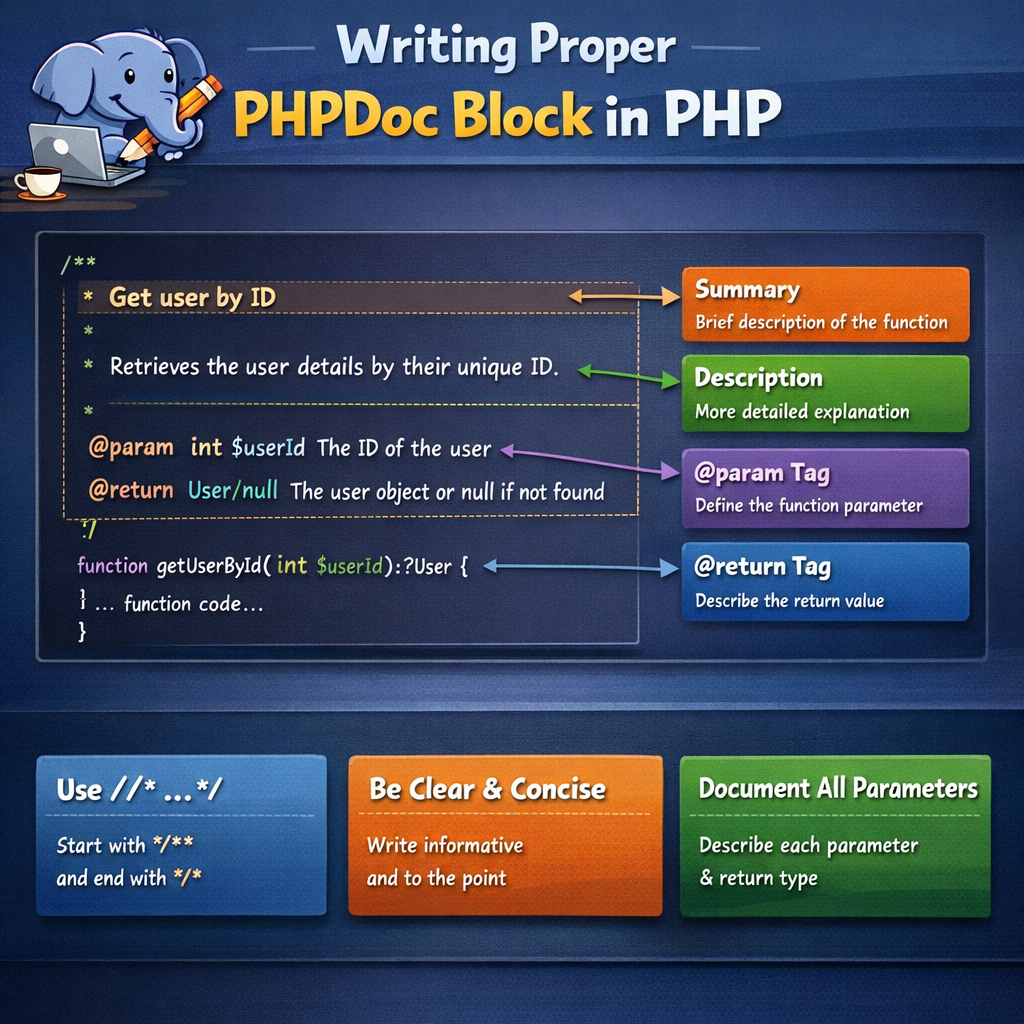
Writing Proper PHPDoc Block is one of the most underrated skills in professional PHP development. If you want maintainable code, better IDE support, automatic documentation generation, and cleaner team collaboration, writing proper PHPDoc block comments is essential. Many developers treat PHPDoc as optional decoration, but in real-world projects, it acts as a contract between your code and other developers. PHPDoc Block correctly ensures clarity, reduces bugs, and improves static analysis.
In this guide, you will learn how to structure PHPDoc blocks correctly, avoid common mistakes, and apply best practices using native PHP only.
What Is Writing Proper PHPDoc Block in PHP?
A PHPDoc block is a structured comment that provides metadata about classes, methods, functions, and properties. It starts with /** and ends with */.
Unlike regular comments, PHPDoc is machine-readable. Tools like IDEs and static analyzers parse these blocks to provide:
- Autocomplete suggestions
- Type validation
- Documentation generation
- Better refactoring support
When writing proper PHPDoc block comments, you are not just documenting code — you are improving development efficiency and code quality.
Basic Structure
A well-structured PHPDoc block contains:
- Short description
- Optional long description
- Tags such as
@param,@return,@throws
Example: Proper Function Documentation
/**
 * Calculate the final price after applying tax.
 *
 * This method applies a percentage tax rate to the base amount
 * and returns the final computed value.
 *
 * @param float $amount The base amount.
 * @param float $taxRate The tax rate percentage.
 * @return float The final price including tax.
 */
function calculateFinalPrice(float $amount, float $taxRate): float
{
    return $amount + ($amount * $taxRate / 100);
}
This is a clean example of Writing Proper PHPDoc Block because:
- The description is clear
- Parameters are explained
- Return type is documented
- It aligns with the function signature
Bad vs Good Example
Let’s compare poor documentation with professional documentation.
/**
 * Get user
 */
function getUser($id)
{
    return ['id' => $id];
}
Problems:
- No parameter type
- No return description
- No explanation
- No clarity
Good Example
/**
 * Retrieve user data by ID.
 *
 * Fetches a user record based on the provided identifier.
 *
 * @param int $id The unique identifier of the user.
 * @return array{id:int} The user data array.
 */
function getUser(int $id): array
{
    return ['id' => $id];
}
This version follows best practices for Writing Proper PHPDoc Block and provides meaningful documentation.
PHPDoc Block for Classes
Classes must also be documented properly.
/**
 * Class UserRepository
 *
 * Handles user data retrieval operations.
 */
class UserRepository
{
    /**
     * @var array<int, array<string, mixed>>
     */
    private array $users = [];
}
When documenting classes:
- Describe the responsibility
- Avoid repeating obvious details
- Focus on intent, not implementation
Proper PHPDoc Block for Properties
Properties must include @var.
Bad Example
/**
 * user list
 */
private $users;
Good Example
/**
 * Stores the list of registered users.
 *
 * @var array<int, array<string, mixed>>
 */
private array $users = [];
Notice how the type is clearly defined. This improves static analysis and IDE hints significantly.
Proper PHPDoc Block for Exceptions
If your method throws exceptions, document them.
/**
 * Find a user by ID.
 *
 * @param int $id The user identifier.
 * @return array<string, mixed>
 * @throws InvalidArgumentException If the ID is invalid.
 */
function findUser(int $id): array
{
    if ($id <= 0) {
        throw new InvalidArgumentException('Invalid ID.');
    }

    return ['id' => $id];
}
This is essential when writing proper PHPDoc block comments in production systems.
Advanced Tips
PHPDoc Block becomes powerful when used consistently across a codebase. In professional environments, PHPDoc is not just about documentation; it is about enforcing structure and clarity in large applications. When working in enterprise systems, developers rely on static analysis tools to detect type mismatches, incorrect returns, or undocumented exceptions. Proper PHPDoc blocks make this possible even in dynamic contexts where strict typing may not be enough.
Another important practice is avoiding redundant documentation. For example, if a method is already strongly typed and self-explanatory, your PHPDoc should add meaningful context instead of repeating the function signature. Good documentation explains intent and edge cases, not what is obvious from reading the code. For instance, instead of saying “Returns array,” explain what the array represents and its structure.
Consistency is also key. Choose one documentation style and apply it everywhere. Keep descriptions concise but informative. Always document:
- Parameters
- Return types
- Exceptions
- Complex array structures
- Business rules
When including proper PHPDoc block comments in large teams, documentation becomes a communication tool. It reduces onboarding time, prevents misuse of methods, and improves maintainability. Well-documented code lives longer and scales better.
Common Mistakes
Avoid these common issues:
- Writing vague descriptions
- Ignoring return types
- Documenting incorrect types
- Copy-pasting outdated comments
- Over-documenting trivial methods
The goal of Writing Proper PHPDoc Block is clarity, not noise.
SEO Benefits
If you publish code examples on blogs or technical documentation websites, writing proper PHPDoc block comments improves content quality and readability. Search engines reward structured, well-organized content. Additionally, developers searching for solutions often look for real, documented examples.
Clear structure, good headings, and proper code formatting increase dwell time and reduce bounce rates.
Conclusion
Writing Proper PHPDoc Block is a professional skill that separates average developers from disciplined engineers. It improves collaboration, enhances IDE intelligence, supports static analysis, and keeps code maintainable.
Start documenting:
- Classes
- Methods
- Properties
- Exceptions
The more consistent you are, the more powerful your codebase becomes. PHPDoc Block is not optional in serious PHP development — it is a best practice that ensures clarity, scalability, and long-term maintainability.