The State Design Pattern in PHP helps you manage complex conditional logic by allowing an object to change its behavior when its internal state changes. Instead of using long if or switch statements, the State Design Pattern in PHP moves state-specific logic into separate classes. This makes your code cleaner, easier to maintain, and more scalable. If you’ve ever struggled with messy conditional blocks that keep growing as your application evolves, understanding this pattern can dramatically improve your architecture.
In real-world PHP applications such as order processing systems, payment workflows, user account statuses, or content publishing flows, objects naturally change behavior depending on their state. A blog post can be Draft, Published, or Archived. An order can be Pending, Paid, or Shipped. Without proper structure, handling these transitions becomes chaotic. The State pattern offers a structured and extensible way to handle these transitions without breaking the Open/Closed Principle.
What Is the State Design Pattern in PHP?
The State pattern is a behavioral design pattern that allows an object to alter its behavior when its internal state changes. The object appears to change its class.
Instead of writing:
- Large conditional statements
- State flags scattered across the class
- Logic mixed with transition rules
You delegate behavior to separate state classes.
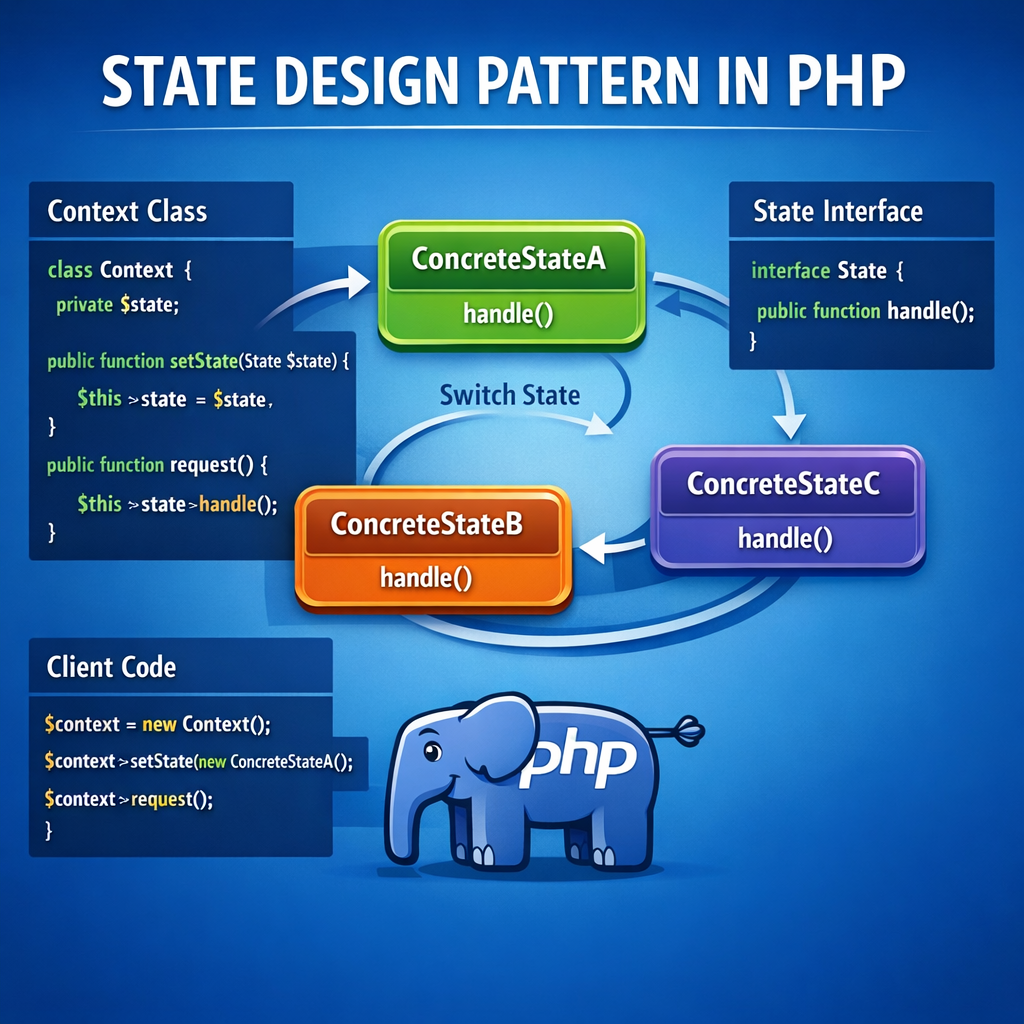
Core Idea
- Context → The main object (e.g., Order)
- State Interface → Defines common behavior
- Concrete States → Implement state-specific logic
Problem: Conditional Logic Gone Wrong
Here’s an example of bad practice.
class Order
{
    private string $status;

    public function __construct()
    {
        $this->status = 'pending';
    }

    public function pay(): void
    {
        if ($this->status === 'pending') {
            $this->status = 'paid';
        } elseif ($this->status === 'shipped') {
            throw new Exception('Order already shipped');
        }
    }

    public function ship(): void
    {
        if ($this->status === 'paid') {
            $this->status = 'shipped';
        } else {
            throw new Exception('Order not ready for shipping');
        }
    }
}
Why This Is Bad?
- Violates Open/Closed Principle
- Hard to extend (What if you add Cancelled or Refunded?)
- Logic grows uncontrollably
- Difficult to test state behavior independently
As the system grows, these conditionals multiply and maintenance becomes painful. Adding a new state forces you to edit existing methods, increasing the risk of bugs.
Implementing the State Design Pattern in PHP
Now let’s refactor using the State Design Pattern in PHP.
First Step: Create the State Interface
interface OrderState
{
    public function pay(Order $order): void;
    public function ship(Order $order): void;
}
Second Step: Create Concrete States
class PendingState implements OrderState
{
    public function pay(Order $order): void
    {
        $order->setState(new PaidState());
    }

    public function ship(Order $order): void
    {
        throw new Exception('Cannot ship unpaid order.');
    }
}
class PaidState implements OrderState
{
    public function pay(Order $order): void
    {
        throw new Exception('Order already paid.');
    }

    public function ship(Order $order): void
    {
        $order->setState(new ShippedState());
    }
}
class ShippedState implements OrderState
{
    public function pay(Order $order): void
    {
        throw new Exception('Order already shipped.');
    }

    public function ship(Order $order): void
    {
        throw new Exception('Order already shipped.');
    }
}
Third Step: Create the Context Class
class Order
{
    private OrderState $state;

    public function __construct()
    {
        $this->state = new PendingState();
    }

    public function setState(OrderState $state): void
    {
        $this->state = $state;
    }

    public function pay(): void
    {
        $this->state->pay($this);
    }

    public function ship(): void
    {
        $this->state->ship($this);
    }
}
Why State Design Pattern in PHP Is Better?
The State Design Pattern in PHP removes conditional complexity and encapsulates behavior inside state classes. Each state handles its own logic and transitions. This makes your application:
- Easier to extend
- Easier to test
- Cleaner to read
- Fully compliant with SOLID principles
When a new state such as CancelledState is introduced, you simply create a new class implementing the interface. You don’t touch existing states. That means fewer regression bugs and safer deployments.
This pattern also improves readability dramatically. Instead of reading through a long method filled with condition checks, developers immediately understand the behavior by looking at the specific state class. It reduces cognitive load and increases maintainability. In large-scale PHP applications such as eCommerce platforms, SaaS systems, or subscription-based services, this design pattern prevents logic explosion and keeps your domain model organized. Over time, this architectural decision pays off because your system evolves without turning into a monolith of nested conditionals.
When to Use the State Design Pattern in PHP?
Use it when:
- An object has multiple states
- Behavior changes depending on state
- You have complex conditional logic
- You frequently add new states
Avoid it when:
- Only two simple states exist
- Logic is minimal
- Overengineering would add unnecessary complexity
Real-World Use Cases of State Design Pattern in PHP
- Order lifecycle management
- Blog post publishing workflow
- Payment processing system
- User account status handling
- Subscription management
In WordPress plugin development, this pattern is extremely useful for handling post status workflows, membership states, or WooCommerce order flows without polluting your main class with conditional logic.
Conclusion
The State Design Pattern in PHP is a powerful way to eliminate messy conditional logic and design flexible, maintainable systems. Instead of allowing state checks to spread across your codebase, you encapsulate them into dedicated classes. This keeps your architecture clean and future-proof.
If you’re building scalable PHP applications and want to follow clean architecture principles, this pattern is a must-have in your toolbox.
Interested in More Design Patterns?
Discover other powerful patterns like Factory, Strategy, and Observer in this full guide: