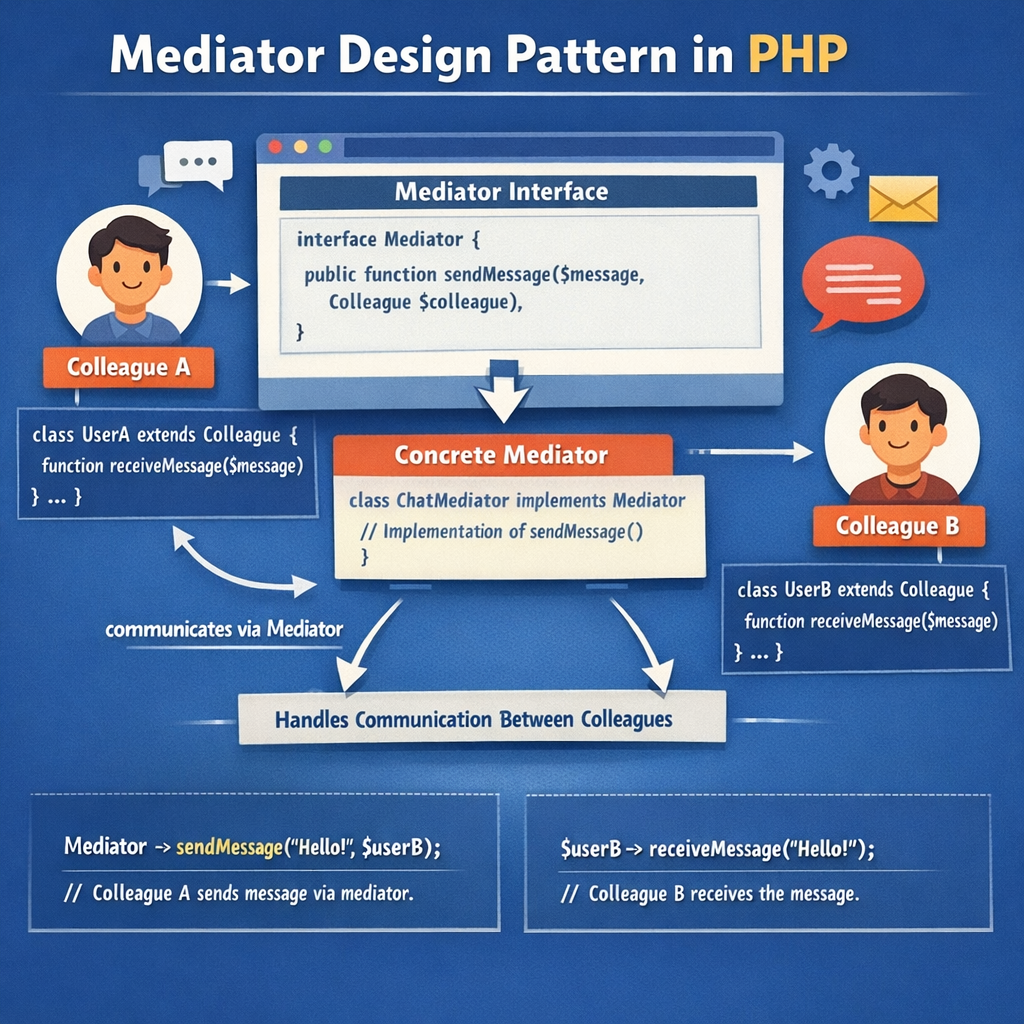
The Mediator Design Pattern in PHP helps you reduce tight coupling between objects by introducing a central object that handles communication. Instead of objects talking directly to each other, they communicate through a mediator. This makes your code easier to maintain, test, and extend. If your PHP application is turning into a web of object dependencies, the Mediator Design Pattern in PHP can restore order and clarity.
In large systems, especially WordPress plugins, admin dashboards, or eCommerce modules, components often depend on each other in messy ways. Over time, small changes create unexpected side effects. The mediator pattern solves this by centralizing communication logic and keeping individual classes focused on their own responsibilities.
What Is the Mediator Design Pattern in PHP?
The Mediator Design Pattern in PHP is a behavioral pattern that defines an object that encapsulates how a set of objects interact. It promotes loose coupling by preventing objects from referring to each other explicitly.
Instead of this:
- Object A calls Object B
- Object B calls Object C
- Object C calls Object A
You get this:
- Object A → Mediator
- Object B → Mediator
- Object C → Mediator
The mediator coordinates everything.
Tight Coupling Between Classes
Imagine a simple chat system where users communicate directly with each other.
<?php

class User
{
    public $name;

    public function __construct(string $name)
    {
        $this->name = $name;
    }

    public function sendMessage(string $message, User $user): void
    {
        echo "{$this->name} sends to {$user->name}: {$message}\n";
        $user->receiveMessage($message, $this);
    }

    public function receiveMessage(string $message, User $from): void
    {
        echo "{$this->name} received from {$from->name}: {$message}\n";
    }
}

// Usage
$john = new User('John');
$jane = new User('Jane');

$john->sendMessage('Hello Jane!', $jane);
Why This Is Bad?
- Users depend directly on each other.
- Adding logging, moderation, or filtering becomes complex.
- Communication logic is scattered.
In a real-world PHP application, this quickly becomes unmanageable when multiple components start interacting.
Mediator Design Pattern in PHP
Now let’s refactor using a mediator.
First Step: Create Mediator Interface
<?php

interface ChatMediator
{
    public function sendMessage(string $message, User $user): void;
}
Second Step: Concrete Mediator
<?php

class ChatRoom implements ChatMediator
{
    private array $users = [];

    public function addUser(User $user): void
    {
        $this->users[] = $user;
    }

    public function sendMessage(string $message, User $sender): void
    {
        foreach ($this->users as $user) {
            if ($user !== $sender) {
                $user->receive($message, $sender);
            }
        }
    }
}
Third Step: Colleague Class
<?php

class User
{
    private string $name;
    private ChatMediator $mediator;

    public function __construct(string $name, ChatMediator $mediator)
    {
        $this->name = $name;
        $this->mediator = $mediator;
    }

    public function send(string $message): void
    {
        $this->mediator->sendMessage($message, $this);
    }

    public function receive(string $message, User $from): void
    {
        echo "{$this->name} received from {$from->name}: {$message}\n";
    }

    public function getName(): string
    {
        return $this->name;
    }
}
Usage
<?php

$chatRoom = new ChatRoom();

$john = new User('John', $chatRoom);
$jane = new User('Jane', $chatRoom);
$bob  = new User('Bob', $chatRoom);

$chatRoom->addUser($john);
$chatRoom->addUser($jane);
$chatRoom->addUser($bob);

$john->send('Hello everyone!');
Why Mediator Design Pattern in PHP Improves Architecture?
The Mediator Design Pattern in PHP centralizes communication logic into one place. This dramatically improves maintainability and scalability in large systems.
When building complex PHP systems—such as admin panels, event dispatchers, booking engines, or plugin architectures—objects often need to react to changes in other objects. Without a mediator, this leads to:
- Circular dependencies
- Hard-to-test code
- Hidden side effects
- Difficult debugging
By introducing a mediator, you isolate communication rules. Objects no longer need to know who they are talking to or how many recipients exist. They simply notify the mediator. This design respects the Single Responsibility Principle because business logic stays inside domain classes, and interaction logic lives inside the mediator.
From a performance perspective, the mediator pattern also gives you a single control point where you can add logging, caching, validation, throttling, or permission checks without modifying individual classes. This is extremely powerful in modular systems like WordPress plugins where multiple components must cooperate without tightly coupling to each other.
When to Use Mediator Design Pattern in PHP
Use this pattern when:
- Many objects communicate in complex ways
- Communication logic is duplicated across classes
- You want to reduce direct dependencies
- You need centralized control over workflows
Avoid it when:
- The system is very simple
- Communication logic is minimal
Mediator vs Observer Pattern
Both are behavioral patterns but serve different purposes.
- Mediator centralizes communication.
- Observer broadcasts state changes to subscribers.
Mediator controls workflow. Observer handles notifications.
Real-World Use Cases
- Chat applications
- Form component interactions
- GUI frameworks
- Workflow engines
- WordPress plugin modules interacting internally
Conclusion
The Mediator Design Pattern in PHP is a powerful solution for reducing tight coupling and simplifying communication between objects. By introducing a mediator, you gain flexibility, maintainability, and cleaner architecture.
If your PHP code feels tangled and hard to maintain, introducing the mediator pattern might be the architectural improvement your system needs.
Start small. Refactor one communication-heavy module. Once you see the clarity it brings, you’ll naturally begin applying it across your architecture.
Interested in More Design Patterns?
Discover other powerful patterns like Factory, Strategy, and Observer in this full guide: