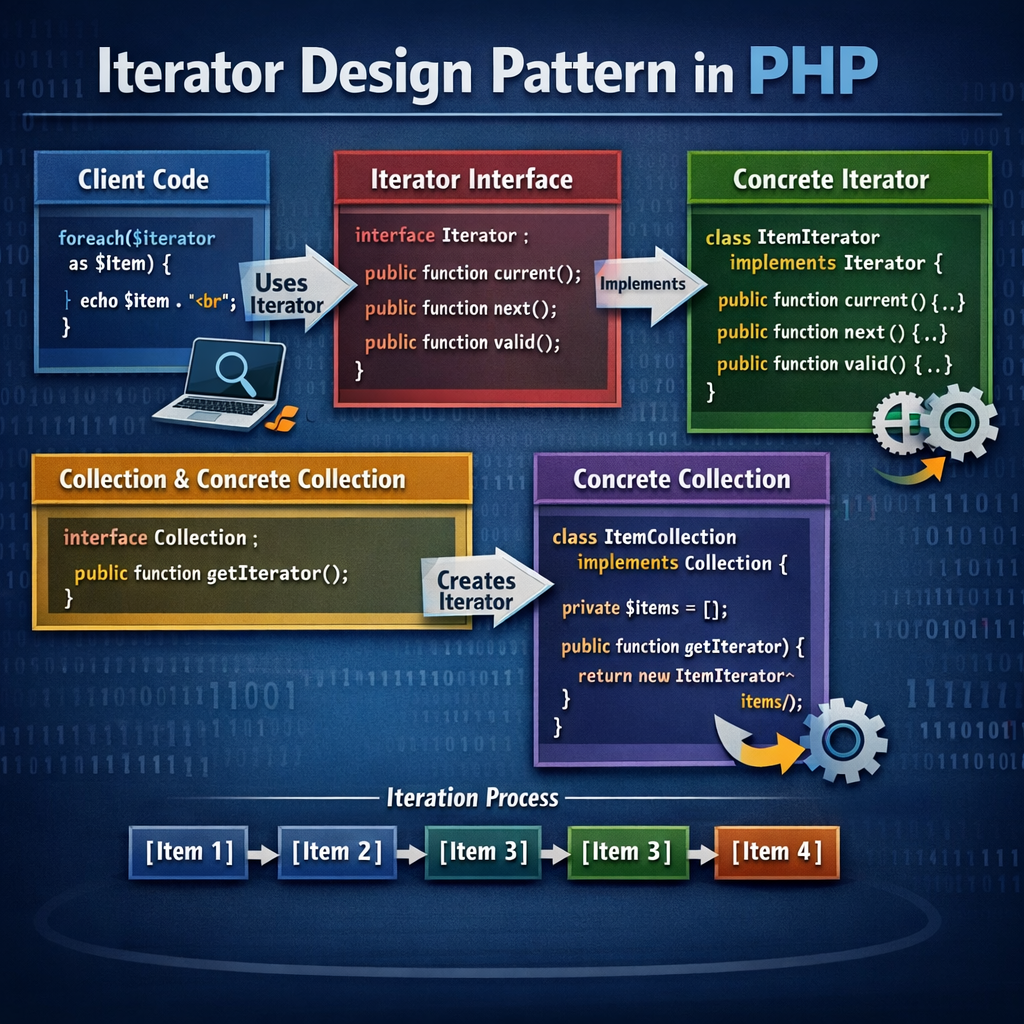
The Iterator Design Pattern in PHP is a behavioral design pattern that allows you to access elements of a collection sequentially without exposing its internal structure. When working with arrays, objects, or custom data collections in PHP, the Iterator Design Pattern in PHP helps you loop through elements in a clean, standardized, and extensible way. Instead of manually controlling loops everywhere in your application, you delegate traversal responsibility to a dedicated iterator object.
This approach improves maintainability, enforces the Single Responsibility Principle, and keeps your business logic separate from data traversal logic. If you’re building scalable applications or WordPress plugins using native PHP, understanding this pattern will significantly improve your code structure.
What Is the Iterator Design Pattern in PHP?
The Iterator Design Pattern in PHP provides a way to access elements of an aggregate object sequentially without exposing its internal representation.
In simple words:
- A Collection stores objects.
- An Iterator knows how to traverse them.
- The client uses the iterator instead of directly accessing the collection.
PHP already provides built-in iterator interfaces like:
- Iterator
- IteratorAggregate
- Traversable
These allow you to integrate seamlessly with foreach.
Why Use the Iterator Design Pattern in PHP?
Many developers directly loop over arrays inside classes. That works for small scripts, but in larger systems, this tightly couples your logic to data structure.
Here’s why you should use it:
- Encapsulates traversal logic
- Supports multiple traversal strategies
- Keeps collections clean
- Improves testability
- Works perfectly with
foreach - Makes WordPress-like data structures cleaner
When your project grows, especially in CMS-based or modular systems, iterators prevent messy loop logic scattered everywhere.
Tight Coupling Without Iterator
Here’s a poorly structured implementation:
class PostCollection
{
    private array $posts = [];

    public function addPost(string $post): void
    {
        $this->posts[] = $post;
    }

    public function getPosts(): array
    {
        return $this->posts;
    }
}

$collection = new PostCollection();
$collection->addPost("Post 1");
$collection->addPost("Post 2");

foreach ($collection->getPosts() as $post) {
    echo $post . PHP_EOL;
}
Problems
- Internal structure exposed
- No control over iteration
- Cannot change traversal strategy
- Breaks encapsulation
This may seem fine today, but tomorrow if you switch from array to database result objects, everything breaks.
Proper Iterator Design Pattern in PHP
Now let’s implement it properly using native PHP.
First Step: Create Custom Iterator
class PostIterator implements Iterator
{
    private array $posts;
    private int $position = 0;

    public function __construct(array $posts)
    {
        $this->posts = $posts;
    }

    public function current(): mixed
    {
        return $this->posts[$this->position];
    }

    public function key(): mixed
    {
        return $this->position;
    }

    public function next(): void
    {
        ++$this->position;
    }

    public function rewind(): void
    {
        $this->position = 0;
    }

    public function valid(): bool
    {
        return isset($this->posts[$this->position]);
    }
}
Second Step: Create Collection Class
class PostCollection implements IteratorAggregate
{
    private array $posts = [];

    public function addPost(string $post): void
    {
        $this->posts[] = $post;
    }

    public function getIterator(): Traversable
    {
        return new PostIterator($this->posts);
    }
}
Third Step: Use It
$collection = new PostCollection();
$collection->addPost("Post 1");
$collection->addPost("Post 2");

foreach ($collection as $post) {
    echo $post . PHP_EOL;
}
Why This Is Better
- Collection is protected
- Traversal logic isolated
- Easily replace iteration logic
- Clean separation of concerns
- Fully compatible with
foreach
Deep Dive: How Iterator Design Pattern in PHP Improves Architecture
When building large-scale applications, especially CMS systems or plugin-based architectures, data handling becomes complex. You might store posts in arrays today, retrieve them from an API tomorrow, and maybe stream them later. If your business logic depends directly on array loops, refactoring becomes painful.
The Iterator Design Pattern in PHP solves this by introducing an abstraction layer between your data and the consumer. Your application code does not care whether the data comes from memory, a file, or a database. It simply loops over a collection. This abstraction creates flexibility and reduces future technical debt.
Another huge advantage is testability. Instead of mocking arrays everywhere, you can mock iterators. This allows more precise control over test scenarios. You can even create specialized iterators like:
- FilteredIterator
- ReverseIterator
- PaginatedIterator
This approach promotes open/closed principle compliance because you extend iteration behavior without modifying the collection itself.
In WordPress-style architecture, imagine iterating through custom query objects. Instead of exposing raw arrays, your plugin can return a collection object that implements IteratorAggregate. That way, theme developers can use foreach naturally, while your internal structure remains protected.
This pattern in PHP is not about complexity. It is about building systems that scale without rewriting half your codebase later.
When Should You Use Iterator Design Pattern in PHP?
Use it when:
- You need custom traversal logic
- Your collection should hide its structure
- You want multiple iteration strategies
- You are building reusable libraries
- You need clean architecture
Avoid it when:
- You are writing simple one-time scripts
- The collection is trivial and will never change
Advanced Idea: Lazy Iteration with Generators
PHP generators offer an innovative approach:
class LazyPostCollection implements IteratorAggregate
{
    public function getIterator(): Traversable
    {
        for ($i = 1; $i <= 5; $i++) {
            yield "Post " . $i;
        }
    }
}
This reduces memory usage and is perfect for large datasets.
Conclusion
This pattern is a powerful behavioral pattern that separates collection logic from traversal logic. It keeps your code clean, scalable, and easy to maintain. Instead of exposing arrays directly, wrap them in a collection object and delegate iteration responsibility to a dedicated iterator.
If you are serious about writing maintainable native PHP code, mastering the Iterator Design Pattern in PHP is essential. It improves architecture, supports clean design principles, and prepares your application for future growth.
Start using it today and transform how your collections behave in your projects.
Interested in More Design Patterns?
Discover other powerful patterns like Factory, Strategy, and Observer in this full guide: