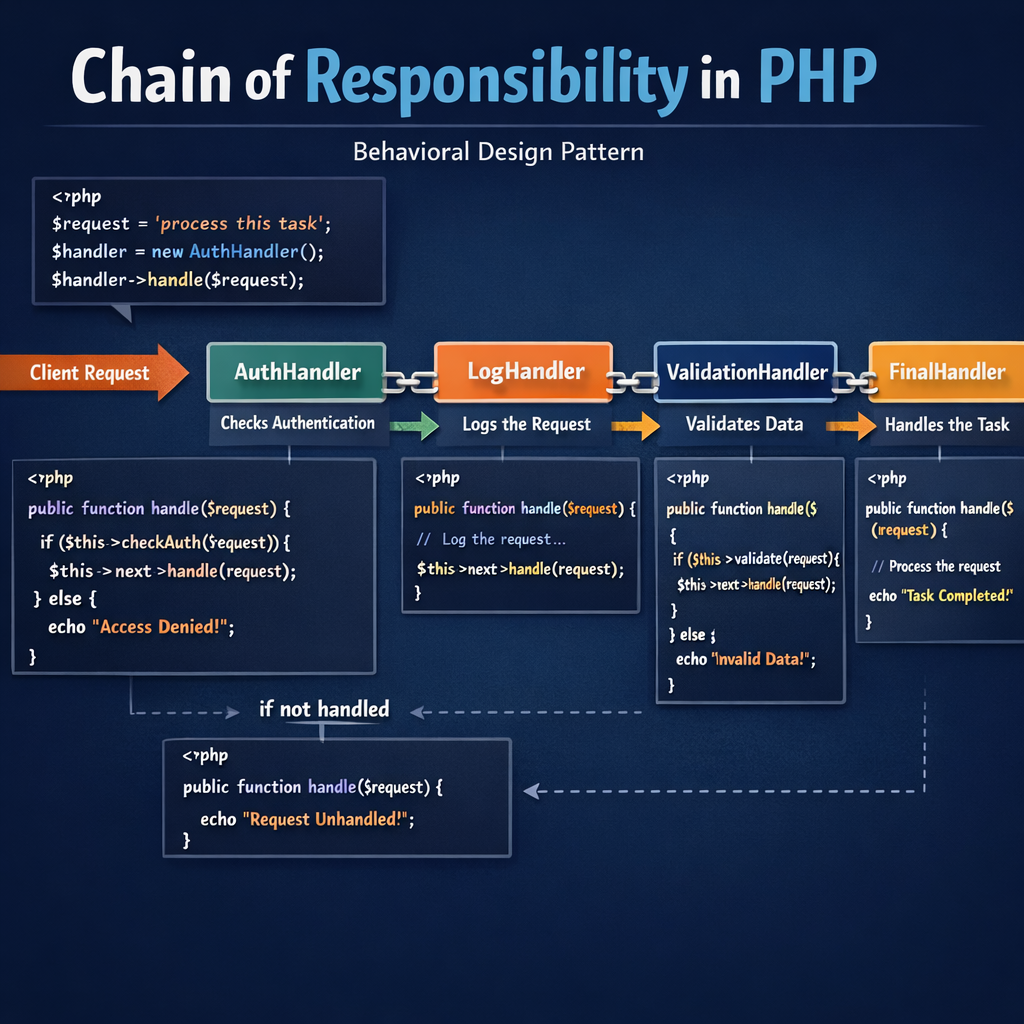
The Chain of Responsibility Design Pattern is a behavioral pattern that allows multiple objects to handle a request without the sender knowing which object will process it. Instead of coupling a request directly to a specific handler, the request is passed along a chain of handlers until one of them handles it. This approach improves flexibility, reduces tight coupling, and promotes clean architecture in large PHP applications.
If you are building scalable systems in native PHP, understanding this pattern is essential. It helps you manage validation pipelines, middleware, logging systems, authentication layers, and many other real-world use cases without writing messy conditional blocks.
What Is the Chain of Responsibility Design Pattern?
The Chain of Responsibility pattern creates a chain of handler objects. Each handler decides:
- Handle the request
- Or pass it to the next handler
This removes long if-elseif-else statements and replaces them with a flexible object-oriented pipeline.
Structure:
- Handler Interface
- Concrete Handlers
- Client
- Request
When to Use Chain of Responsibility Design Pattern
Use this pattern when:
- Multiple objects can handle a request.
- The exact handler is unknown in advance.
- You want to decouple sender and receiver.
- You want dynamic processing pipelines.
Common real-world examples:
- Authentication middleware
- Form validation systems
- Logging levels
- Payment processing workflows
- Role-based access systems
Conditional Hell in Native PHP
Here’s how developers often write request handling logic:
class OrderProcessor
{
    public function process($order)
    {
        if ($order['amount'] < 100) {
            echo "Processed by Junior Manager";
        } elseif ($order['amount'] < 1000) {
            echo "Processed by Manager";
        } else {
            echo "Processed by Director";
        }
    }
}
Why This Is Bad?
- Violates Open/Closed Principle
- Hard to extend
- Tight coupling
- Difficult to test
- Grows uncontrollably in large systems
Adding new approval levels means modifying existing code. That’s risky and unscalable.
Chain of Responsibility Design Pattern
Now let’s implement it properly using native PHP.
First Step: Create the Handler Interface
interface Handler
{
    public function setNext(Handler $handler): Handler;
    public function handle(array $request): ?string;
}
Second Step: Create an Abstract Handler
abstract class AbstractHandler implements Handler
{
    private $nextHandler;

    public function setNext(Handler $handler): Handler
    {
        $this->nextHandler = $handler;
        return $handler;
    }

    public function handle(array $request): ?string
    {
        if ($this->nextHandler) {
            return $this->nextHandler->handle($request);
        }

        return null;
    }
}
Third Step: Create Concrete Handlers
class JuniorManager extends AbstractHandler
{
    public function handle(array $request): ?string
    {
        if ($request['amount'] < 100) {
            return "Processed by Junior Manager";
        }

        return parent::handle($request);
    }
}

class Manager extends AbstractHandler
{
    public function handle(array $request): ?string
    {
        if ($request['amount'] < 1000) {
            return "Processed by Manager";
        }

        return parent::handle($request);
    }
}

class Director extends AbstractHandler
{
    public function handle(array $request): ?string
    {
        if ($request['amount'] >= 1000) {
            return "Processed by Director";
        }

        return parent::handle($request);
    }
}
Last Step: Build the Chain
$junior = new JuniorManager();
$manager = new Manager();
$director = new Director();

$junior->setNext($manager)->setNext($director);

$order = ['amount' => 1500];

echo $junior->handle($order);
Why Chain of Responsibility Design Pattern Is Better
This pattern removes rigid conditional logic and replaces it with object composition. Instead of hardcoding decision trees, you assemble a processing pipeline dynamically. This makes your code easier to maintain, extend, and test independently. Each handler has a single responsibility, which aligns perfectly with SOLID principles.
Another major benefit is runtime flexibility. You can reorder handlers, remove them, or inject new ones without modifying existing classes. Imagine building an authentication system where you want to add rate limiting, logging, and token validation. With this pattern, you simply insert a new handler in the chain.
In large enterprise PHP applications, conditional logic becomes technical debt quickly. The Chain of Responsibility Design Pattern prevents that by distributing logic across specialized classes. It keeps your controllers thin and your business logic organized. This approach is especially powerful when building APIs, middleware systems, or event-driven applications using pure PHP.
Real-World Use Case: Validation Pipeline
Imagine validating user registration:
- Check required fields
- Validate email format
- Check password strength
- Verify uniqueness
Each validation rule becomes a handler. If one fails, the chain stops. Clean. Maintainable. Scalable.
Advantages
- Reduces coupling
- Follows Open/Closed Principle
- Improves maintainability
- Encourages Single Responsibility Principle
- Makes testing easier
- Supports dynamic runtime configuration
Disadvantages
- Debugging chain flow may be harder
- No guarantee a request will be handled
- Slightly more complex than simple conditionals
Conclusion
The Chain of Responsibility is a powerful behavioral pattern for building flexible and scalable systems using native PHP. It replaces bloated conditional logic with a clean, object-oriented processing chain.
If you want to write clean architecture code, avoid large if-else blocks, and build extensible systems, this pattern is a must-know. Use it in validation systems, middleware pipelines, logging frameworks, and approval workflows.
When applied correctly, the Chain of Responsibility Design Pattern will dramatically improve your code quality and maintainability.
Interested in More Design Patterns?
Discover other powerful patterns like Factory, Strategy, and Observer in this full guide: